Affichage des articles dont le libellé est politics. Afficher tous les articles

vendredi 8 mars 2013

Tim Miller

Tim Miller is a Los Angeles-based performance artist, and a key founder of P.S. 122 in New York and Highways Performance Space in Los Angeles. He's one of the 4 performance artists who was denied funding and sued the National Endowment for the Arts (the NEA Four).

"I sometimes feel this border between my body and some friends who are really sick right now. It's like this nice coastline on your arm here. It's a border I want to cross, though. A coastline I want to pull people to. Maybe you have brought a special life preserver and you can teach me how to use it and we can throw it to all our friends who are sick and we can pull them back to shore. I want to hold these bodies really close so that not one more slips away." (Miller, My Queer Body)

"Mourning and celebration are the two poles of this life. I know they are often hovering quite near the surface of the community that gathers to see my work. These charged feelings are quite present in the theatres that I step out into, asking spectators to shout out a favorite place on their bodies. I know I am a queer performer presenting my homo-content work in a time of crisis. My work is also filtered through a complex set of political events around the right wing's attempt to censor lesbian and gay artists. Perhaps this makes these human gatherings for the work more pregnant with feeling and need. The call to community more pointed. I want to feel the full blast of the humanness of the situation. I want, as a performer, to be pulled and challenged" (Miller and David Román, "Preaching to the Converted," Theatre Journal. 47:2, 1995)

"The financial vulnerability of the queer arts is most often the result of an anti-art sentiment endemic in contemporary U.S. culture and, more directly, of the cultural wars fueled by the ongoing crisis of the National Endowment of the Arts; it is not the result of the artistic failure of queer artist" ("Preaching to the Converted")

"Performance artists are tackling the blood and bone of the society...A lot of it is not pretty, but our culture is not about Swan Lake" (Miller, qtd. in People Magazine)

mardi 5 mars 2013

John Frohnmayer

Chairman of the NEA from 1989-1992, Frohnmayer largely bowed to political pressure from the religious right to deny finding to controversial artists, but did fend off Congressional attempts for more restrictive funding oversight by Congress.

Frohnmayer personally overrode the recommendations of a panel of experts in order to deny funding to individual artists (the NEA 4). He also instituted a policy requiring artists to sign an anti-obscenity pledge.

Headlines and Quotes

"Bending to the Political Winds, the NEA Cuts Off Grants to Four Artists Amid Charges of Censorship" (People Magazine, August 6, 1990)

"All artists are interconnected," says Papp. "The most outspoken people help other artists take chances. Once you start to cut at the fringe, you start to cut at the entire body, and then you'll get second-class stuff—art that is afraid." (Joseph Papp, head of the Public Theater, quoted in People Magazine)

"NEA Chairman's abiding by a policy of fear" (Eugene Register-Guard)

The Villains of the Culture War

These are the most public voices in the controversies and censorship battles of the 1980s and 1990s:


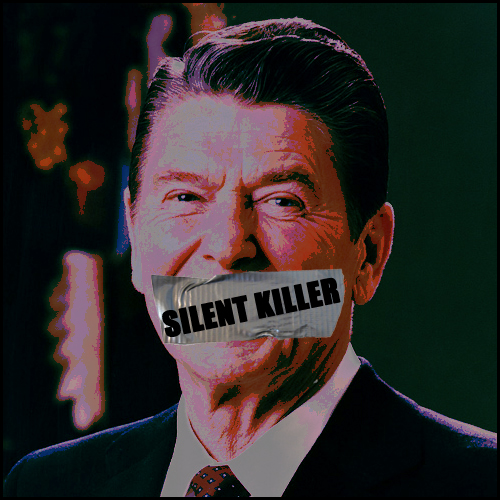
President Ronald Reagan


President George H. W. Bush


North Carolina Senator Jesse Helms


NEA Chairman John Frohnmayer


Orange County Representative Dana Rohrabacher


Dick Armey, Republican House Majority Leader


Pat Buchanan, senior advisor to Ronald Reagan and 1992 and 1996 Presidential candidate

mercredi 20 février 2013

Dick Armey on NEA funding

TV journalist Larry King discussing NEA funding of Robert Mapplethorpe exhibit, with conservative Congressman Dick Armey as a guest. Armey begins talking at 3:45. At 7:56, he says "Every artist has in his heart some place a desire to offend the bourgeois middle class values"

mardi 19 février 2013

Jesse Helms


Excerpts from 1998 film Dear Jesse, in which a gay filmmaker explores his relationship to Jesse Helms. Helms was an American politician and extremely conservative U.S. Senator who became the face of anti-gay censorship. In 1987, Helms was responsible for enacting a ban that prevented people with HIV from traveling to the United States. This ban was in effect until President Obama appealed it in 2009.

Helms was also the key figure in denying funding for gay artists through the National Endowment for the Arts (NEA). In 1989, Senator Helms publicly denounced Andres Serrano's photograph, Piss Christ, which was being displayed as part of an NEA-funded exhibition.


Helms claimed "There is not one single case of AIDS in this country that cannot be traced in origin to sodomy" (States News Service, 5/17/88, qtd. in a FAIR.org press release) and described homosexuals as "weak, morally sick wretches" (Newsweek, 12/5/94, qtd. in Fair.org press release)

In 1995, for example, Helms told The New York Times that the government should spend less money on people with AIDS because they got sick as a result of "deliberate, disgusting, revolting conduct." (qtd. in the Washington Post). “We’ve got to have some common sense about a disease transmitted by people deliberately engaging in unnatural acts,” (Helms in the New York Times, qtd. at Americablog). “Nothing positive happened to Sodom and Gomorrah,” he said, “and nothing positive is likely to happen to America if our people succumb to the drumbeats of support for the homosexual lifestyle.” (Helms qtd. in the New York Times)


In 1989, Helms proposed an amendment to the NEA budget that would restrict the organization from funding "obscene or indecent" art. This is known as the "Helms Amendment." Congress passed a bill that banned federal funds for art that "may be considered obscene, including but not limited to, depictions of sadomasochism, homoeroticism, the sexual exploitation of children, or individuals engaged in sex acts and which, when taken as a whole, do not have serious literary, artistic, political or scientific value."

Koch, Cynthia. "The Contest for American Culture: A Leadership Case Study on The NEA and NEH Funding Crisis." Public Talk: Online Journal of Discourse Leadership. 1998. University of Pennsylvania. 19 Feb. 2012. Web.

Helms called the NEA "the upholstered playpen of the arts and crafts auxiliary of the Eastern liberal establishment" (exhibit on editorial cartoonist Pat Oliphant from The Library of Congress)


Helms on art: “The self-proclaimed, self-anointed art experts would scoff and say, ‘Oooh, terrible,’ but I like beautiful things, not modern art,” (Helms, qtd. in the New York Times, 1989)


jeudi 31 janvier 2013

Dramaturgie culturelle


SIDA et les annees 80s.


"Les personnalités fabuleuses années 1980 à New York"